Bookmark and Share Torchwood: Miracle Day - Dead of Night

Thursday, July 28, 2011 - Reviewed by Anonymous

Written by Paula Seligson

Torchwood: Miracle Day - Dead of Night
Written by Jane Espenson
Directed by Billy Gierhart
Broadcast on Starz - July 22 2011
BBC Worldwide Productions
This review contains plot spoilers and is based on the US broadcast of the episode.

A team dynamic has returned.

When Torchwood first hit television, it was described as Jack’s spinoff. But by the end of the first episode, the audience knew the show would focus on the Torchwood team, not just Jack. The previous two episodes of Miracle Day were lacking because there was no team dynamic. We had Gwen and Jack, and Rex and Esther. These four are now finally working on the same side, along with Dr. Vera Juarez.

Though a team dynamic has returned, the team dynamic has not. Jack, Gwen, Toshiko, Owen, Ianto - these five worked together as friends and with trust. The new ‘team’ formed from necessity, and is rightfully on very shaky ground. We see Rex challenge Jack’s leadership, ultimately deferring to him but then walking away and later returning. Esther grapples with her lack of experience and self-confidence, echoing Gwen’s first episodes of uncertainty at her ability to do the job. Jack, though a leader to Rex and Esther, defers to Gwen. And Gwen takes the most leadership, at a level of self-confidence not before seen in the show.

Jack and Gwen’s semi-role reversal finally gives insight into Jack. He’s mortal for the first time in thousands of years, and he wants to enjoy it, revelling in discomfort and hilariously even a hangover. But more than his mortality, he’s letting Gwen into his life. Instead of putting up a strong front as the sole leader of the group, he acknowledges (and she also interrupts and reminds him) that she’s competent and knows what she’s doing. In doing so, he also acknowledges that he’s not ‘okay’ from the events of Children of Earth. As he reveals the lasting effects of that finale, it leads to one of the best scenes in the show so far: Jack’s confrontation with Danes.

Danes is creepy and disturbing, and his description of how much he enjoyed raping and murdering the young girl left me feeling legitimately disgusted. He assumed Jack was like him, and just watching Jack’s expression change from one of anger to guilt and then to revulsion was disarming. Danes reveled in the murder of a child, and Jack listened with first-hand experience. Jack expected a monster and he found one. Of all the people affected by the Miracle, this man is the one becoming the next Jesus-like cult leader, deceiving foolish and desperate people looking for some kind of sense in the world. We now see his role in the show, and it’s one hell of a social commentary that I can’t wait to see progress.

But this conversation with Danes also revealed how fragile Jack has become. Not that he’s close to breaking or no longer being the Jack we all know and love - that would be a ridiculous cop-out. He has thousands of years of experience and is an impossibly strong person. Regardless of the horrible choices he’s had to make, he’s still the hero who will save the day. Yet all those years weigh on his shoulders and soul, and before that didn’t matter, because he had to keep going. But now things have changed - Jack is mortal. The writers are emphasizing his mortality not by just his actions - like ignoring the world for a night of sex - but also through his emotional exhaustion - his heartbreaking phone call to Gwen. I think they’re foreshadowing how he will deal with the Miracle at the end of the season. Because Jack saw himself in Danes; he saw a man with a deathwish.

As for the plot, it continues to unfold at a slow pace, throwing a bone or two to the audience each episode. PhiCorp either caused the Miracle or knew about it and chose not to tell anyone. And why? For profit. They’re pushing their agenda for a world with no drug prescriptions, pushing it via Danes and a terrified populace, with drugs stockpiled using Timelord technology.

I’m still waiting for the shocks and twists bound to appear that will make this quintessentially Torchwood, and find myself impatient at the tantalizing speed of the storytelling. This story is much slower than the other seasons, and it allows for more analysis of the affects of the plot - like Danes’ being noticed and attacked by two people and then picked up and beaten by the police, the cult with the masks, and a night full of sex for some and work and uncertainty for others. The slower storytelling creates more attachment to the plot through the characters, and hopefully wont cause the episodes to become boring as the story progresses.

But what of the growing team dynamic? Rex and Vera are ‘not strictly professional’ while Esther pines after him. Jack is trying to become closer to Gwen while she’s more focused on the Miracle and her family. Esther will hopefully come into her own as she faces new challenges, perhaps with the guidance of the obviously-impatient and frustrated Gwen. Rex continues to deal with his constant pain, and grapples with essentially being a solo agent, no longer tied to the CIA, an organization he’s dedicated his life to. And Vera attempts to find solutions for this entire mess, getting roped into Torchwood through her role as a surgeon and her access to PhiCorp. Jack and Gwen’s partnership carries the direction and expertise of the group, but the other three contribute, trying to make sense of the new world with their own respective skills. The five have the potential to recreate Torchwood, but as of yet have not succeeded. There are essentially two members of Torchwood, and three trainees.

They’re not a team yet, but they’re becoming one.

Bookmark and Share Torchwood: Miracle Day - Rendition

Monday, July 25, 2011 - Reviewed by Anonymous

Written by Paula Seligson

Torchwood: Miracle Day - Rendition
Written by Doris Egan
Directed by Billy Gierhart
Broadcast on Starz - July 15 2011
BBC Worldwide Productions
This review contains plot spoilers and is based on the US broadcast of the episode.

Torchwood is taking advantage of its longer time-frame.

With 10 episodes, 50 minutes each, instead of the usual 45 minutes for a ‘monster of the week’ or the miniseries of Children of Earth, we finally get to see not only the action of the plot but also its greater ramifications for both the Earth and the characters.

Rendition continued exploring the Miracle into the extent of its world-impact. This isn’t just the Torchwood team trying to save the Earth from a threat only they know about. This isn't Doctor Who where only the Doctor and maybe his companions can save the day. The Miracle is affecting the whole world, and that means the world’s best minds are going at the issue because everyone has a stake in what has happened.

That’s why I loved Dr. Juarez’s scene where she reverses triage. She understands how few resources her hospital has when nobody can die, and she realizes that a doctor’s most lacking commodity - time - is no longer an issue. This extends into her attendance at the panel, where we realize that illnesses will soon become resistant to drugs, and the most in-demand drugs will be painkillers. Logical steps like these turn Torchwood into good science fiction, which discusses how people deal with new issues and what ramifications those issues have on culture and resources.

The cultural aspect is prominent through Danes. The use of social media, ranging from the Twitter hashtag #forgive to memes about Danes’ failed execution like the Youtube video ‘what did you do?’, show why Danes is a character at all. As Esther says, “It’s the miracle made visible.” But she also comments on another interesting development: reconciliation between India and Pakistan, going completely against how she thought those cultures would react. It’s details like these that I hope the show continues to include, because they are what set it apart from a fun and dark ‘scifi’ action show into something that really analyzes human behavior and comments on society.

Gwen and Jack’s interactions continue to be a highlight of the show I love Gwen’s conflicting feelings of anger at Jack for leaving and for then returning, her fear for her family, and her relief and joy at having Jack and all the action of Torchwood back in her life. The entire scene where Jack is poisoned and Gwen, Rex, Juarez, and the flight staff work to save his life was just, simply put, well done. Her concern for Jack and her utter refusal to let him die are characteristic of how much stronger Gwen has become as a person since she first joined Torchwood.

Jack is still as cocky and in-control as always, which make his interactions with Rex a welcome comic relief. He is also finally being open with Gwen, as shown in one of my favorite dialogue exchanges in the episode:

Gwen: Where did you go, Jack?
Jack: A long way away.
Gwen: And did it help?

Jack just looks away, and doesn’t try to lie to Gwen and say that he’s fine. He’s no longer portraying himself to be the unshakable leader when he’s with Gwen, which shows how much their relationship has grown.

Also, point of interest: Jack’s guess about morphic fields causing the Miracle (confirmed by the CIA’s response of attempted assassination) is actually from the conjectures of the real scientist Rupert Sheldrake: http://www.sheldrake.org/Articles&Papers/papers/morphic/morphic_intro.html
I’m very excited to see how the writers take Sheldrake’s ideas and make them real for the show.

So far, Torchwood continues to be a strong show with a good mix of plot, characters, and action. The chase scene when Esther escaped from the CIA, the moments where Rex stared at himself in the bathroom mirror on the plane and questions again why he was still alive, and Danes’ disturbing breakdown of ‘I’m sorry’ on national television are all examples of continuing strong scenes in the show. I also love the bones the writers keep throwing at the new audience to hint at information only previous Torchwood fans would really know, especially in regards to Jack’s immortality, like when he says he had a boyfriend in the 1800s who used arsenic. The plot is progressing by revealing a bit each episode, and it’s fun to keep the mystery going. The new information in this episode - the morphic field, the oscillating level of life, and the fact that people are still aging - is all intriguing and I can't wait to see what is revealed next.

But of the two new characters, I only like PR rep Jilly Kitzinger. She is sly, developing the plot, and downright creepy with her smile and business cards. She’s interesting. On the other hand, Rex’s old love interest, CIA agent Lyn Peterfield, is too stereotypical to keep my interest. She’s exactly what you’d expect from a high-security-clearance CIA agent. And her ‘death’ was too camp - I felt like I was watching a zombie horror film when she walked toward the car with her head twisted around. Although she gets points for another really disturbing Torchwood moment.

Another issue I had with the episode was the gay flight attendant, Danny. I felt like every joke centered around him fell short. The jokes themselves felt juvenile, and at the least should have involved Jack flirting with Danny. Humor, usually very dark, is part of Torchwood, and it would be wrong not to have comic relief throughout an episode. But a character like Danny highlights an issue with longer stories. With a short length and time limit, writing has to be tight. Every word must count. But when a story becomes longer, and without the pressing need to make every moment necessary, quality can be lost. I felt like that’s what happened with Danny.

It’s wonderful for the story to not feel rushed. Scenes are longer, letting us see more nuances in the characters facial expressions and mannerisms, like Danes’ slight and sly smiles, and the beats between Jack and Gwen that are always filled with either silent communication or unspoken emotions. The full story gets to unfold in the style of a very long movie, allowing for a slower and more comfortable evolution of the plot as well as more character development. Hopefully this freedom in length wont diminish the quality of the show.

Bookmark and Share Torchwood: Miracle Day - The New World

Tuesday, July 19, 2011 - Reviewed by Anonymous

Written by Paula Seligson

Torchwood: Miracle Day - The New World
Written by Russell T Davies
Directed by Bharat Nalluri
Broadcast on Starz - July 8 2011
BBC Worldwide Productions
This review contains plot spoilers and is based on the US broadcast of the episode.

Torchwood is back. There are differences - more explosions, American-geared jokes, and cinematography no longer based on the confines of a city. But the feel of a science fiction story grounded with people and taken to the edges of dark and disturbing is the same.

It begins dark. A convicted rapist and murderer of a young girl, Oswald Danes, is prepped for execution by lethal injection. The mother watches, hoping for closure from his last words, and cries as Danes dismisses her and waits for death. Immediately the plot (already spoiled by the previews for the episode) is introduced. The liquid enters the man’s veins and he thrashes in agonizing pain, undying.

And so Miracle Day starts.

This episodes begins with why I love Torchwood. With Danes’ unsuccessfully completed execution, it immediately shows the horrible nature of the Miracle: if people can’t die, what does that mean for the pain they suffer when death wont release them? With Danes, we see horrible pain but no other side-affects because the drug simply passes through his body.

With CIA agent Rex Matheson we see an unhealing injury. Even in the promo pics, he’s depicted with a bloody shirt.

And of course with the exploded assassin, we see the abject horror of the Miracle. What happens when a person’s body is damaged beyond function? They keep living.

The episode rightfully takes the time to explain the mystery of Torchwood for the new American audience just tuning in, with echoes of season one: finding an old picture matched to a modern-day Jack and retcon. The two accessible characters - Rex and fellow CIA agent Esther Drummond - are believable. Rex is portrayed as arrogant and in search of advancing his own career, but ultimately with a very personal stake in the mystery of the Miracle. The joke about the toll bridge fell short, but hey, the guy is in a lot of pain, you can’t expect to have a sound sense of humor. Esther’s obvious (and unrequited) feelings for Rex are an expected addition to the character interactions (there’s always a romance) and will be interesting to see unfold. Esther shows she’s both inquisitive and self-directed by seeking out information on Torchwood despite being told not to bother, which is encouraging for her later character development.

Of the new characters, the surgeon, Vera Juarez, is the most interesting, due to both her personality and her experiences while standing at ground zero of the Miracle - the ER.

We’re just getting to know the new main characters, and so far so good. Esther is definitely the weakest, but that leaves the most room for character development. All are in the thick of the Miracle’s effects, and they each deal with their respective burdens in different ways. The only one I’m not sure about is Danes, because his side-plot seems extraneous, and so far is the weakest portion of the show. Still, I’m excited to see what directions the writers take the new characters.

But if you’re a returning fan, they’re not why you’re watching the show. Jack, Gwen, and Rhys were fantastic.

Gwen has reached a new level of bad-ass, now that she’s a mother protecting her child. The scene where the couple comes to her and Rhys’ door for directions was brilliant. I love the new level of fierceness she brings to fighting. She has her daughter and her husband, she has reclaimed her life from Torchwood, and she will not let ANYONE ruin that for her.

I am so glad they didn’t change Rhys and Gwen’s relationship. He’s just as annoying and against Torchwood as he’s always been, and it’s a wonderful counter-perspective to Gwen’s readiness to jump in and save the world. While Gwen protects her family from the dangers of the world, Rhys has to protect Gwen from herself and her willingness to get involved. Their argument in the hospital was wonderful, and the best example possible of why Rhys is a worthwhile character to have around. I especially loved his readiness to handle a weapon and fight, revealing how much he’s grown since the start of the show.

And of course, Jack! Saving the day, one rocket launcher at a time. His reunion with Gwen was quick but well-done. Just the sheer look of joy on Gwen’s face (and the disgruntled scowl from Rhys) made me grin in delight - what’s left of the team is back together. Their reunion leaves fans wanting more, which I am confident the writers will deliver in the coming episodes.

And their reunion reveals the biggest shock of the episode - Jack is now mortal.

Plotwise, along with Torchwood being broadcast in the CIA headquarters before Jack wiped it from the entirety of the internet, it seems as though Jack’s presence is connected to and possibly causing the Miracle, and perhaps was even a trap for him. But could it instead be that whatever is causing the Miracle has managed to supersede Jack’s immortality, making him able to be injured but still (like the rest of Earth) unable to die? We’ll have to wait and see, but the plot is extremely intriguing and I can’t wait to see where they take it.

And yet the most interesting aspect of Jack’s mortality is not even the plot, but himself as a character.Jack has been immortal at this point for thousands of years. He has suffered in horrific and excruciating ways, and even spent his first few hundred years trying to find the Doctor in order to regain mortality. For now, in the thick of the plot, he’s most concerned with protecting Gwen and saving the Earth. But does Jack want to die?

We watch him casually suggest decapitating the exploded assassin in a truly cringe-worthy scene, all the while knowing he’s been through a similar experience during Children of Earth. The audience rarely sees the inner psyche of Jack. We see him endure horrible experiences, and he always seems to absorb whatever is thrown at him, back to his flirtatious old self by the next episode. But by the end of Children of Earth, he finally leaves because he’s suffered too much on his home planet.

Now that he has the chance to die, will he take it?

I suspect the finale of this story arc may be Jack’s choice between death or immortality, a choice that will decide the fate of the Earth.

In the meantime the fascinating plot will continue to unfold as the entire world deals with an increasing population and a growing number of injured who should but cannot die. The New World was an exciting start to a 10-episode season, slow paced enough to let the show right itself on American soil, but still full of action and adventure. And most importantly, it was still distinctly Torchwood.

Bookmark and Share Torchwood: Miracle Day - preview and Q&A at the BFI

Tuesday, June 21, 2011 - Reviewed by Chuck Foster


Yesterday, UK fans got their first real taste of what to expect from the new series of Torchwood, with the first episode of Miracle Day shown as a special preview at the BFI. Interest in the episode and the chance to hear cast and crew talk about it swept across the Net very quickly, with tickets sold out within a few hours of going on sale!

These kinds of events are a good time to catch up with friends you only ever really seem to meet at conventions and the like; the Internet has made chatting so easy now that you can sometimes forget what people look like - or indeed not know who they are when they've only ever been behind the text on your screen! And with so many fans together in a relatively small environment it is inevitable that both the enthusiasm and pensiveness of the gathering bleeds together - great, it's finally back - will it be too American? - how do you follow Children of Earth? - it's BILL PULLMAN! - and so on ...

So would the episode live up to anticipation?

Episode One - The New World

(the following is a spoiler-free review of the episode, but some aspects might be considered spoilers for those who don't know the premise and press details for the show)

Well, yes really. I must admit its opening scenes had me worried, as it did come across as a bit of "American twee" - this feels so familiar from those endless shows that work their way through the schedules of Sky, Universal and FX. However, it doesn't take long to forget this - within a couple of minutes you're witness to a scene that makes it clear that this show could never be on before the watershed. And I realised afterwards that I'd already accepted the style of the show by the time we reached the Welsh 'wilderness' - substitute "filmic" for "American" now!

The story plays out quite slowly - there are some 10 episodes to fill after all - and it did seem longer than Children of Earth in spite of the running time, though this might of course be down to how engrossing the storyline becomes. It certainly isn't boring, and there are plenty of the traditional Torchwood trappings and set pieces to jolly it along. Not to mention quite a bit of humour, both light and dark ...

In some ways it felt a little like a reboot - as with Everything Changes (and Rose/Smith and Jones in Doctor Who) the story unfolds in the eyes of those naive to what they are about to encounter. However, Miracle Day is a continuation of Torchwood, with references to the former series and of course in the development of the characters we already know and love and re-meet as the episode progresses.

Director Bharat Nalluri makes excellent use of the Welsh and Californian locations that feature in the story, and the flitting between the two locations is seamless. As I mentioned earlier, there are some very filmic moments (sweeping landscapes, grand sets, both real and studio), and this is reflected by composer Murray Gold, whose music could almost be out of a Bond movie at some points! Indeed, there is little to connect this with the "house" style of his Doctor Who opuses, and all the more better for it - though of course he pays homage to the familiar Torchwood stings we know of old.

Question and Answer session

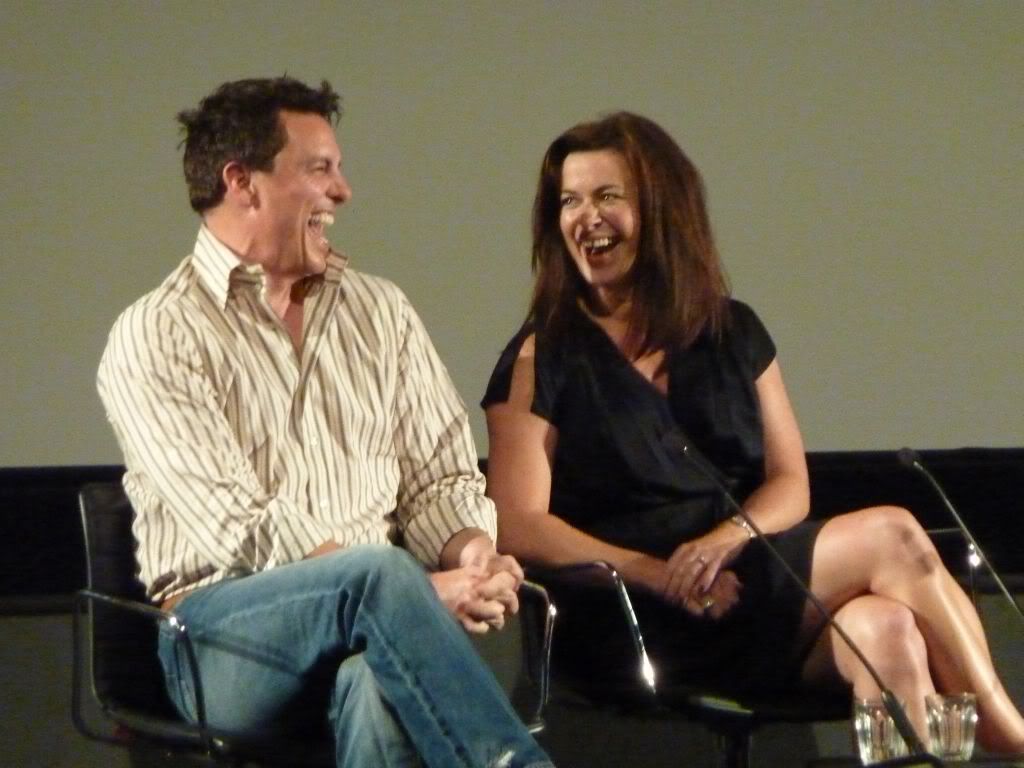
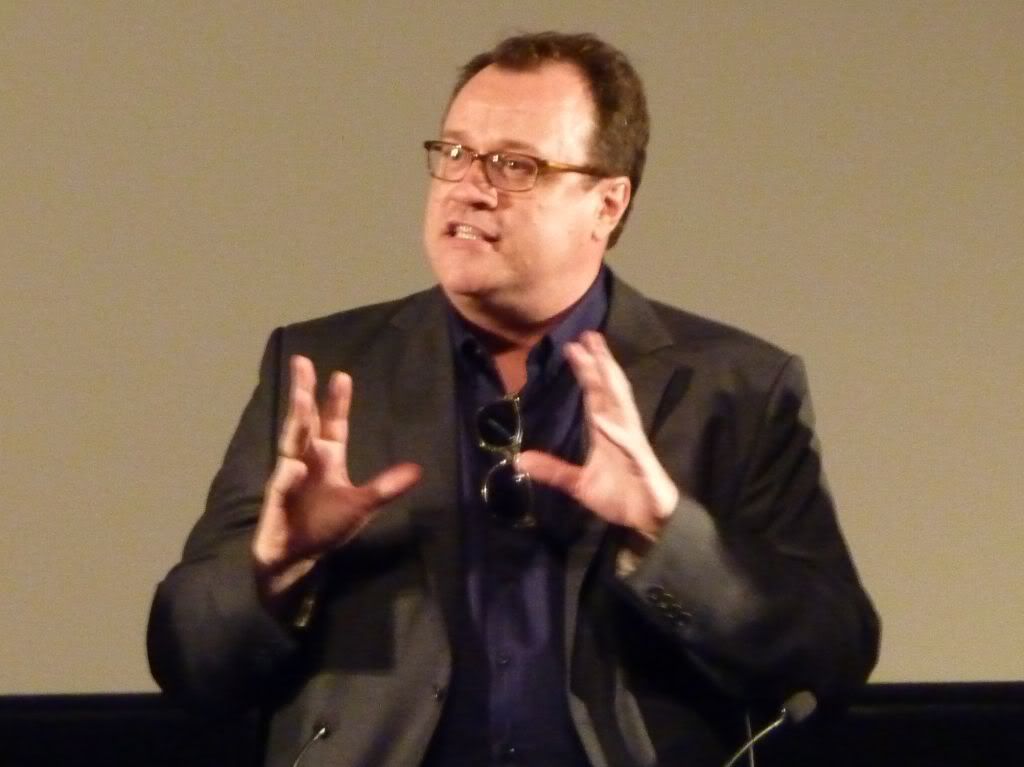
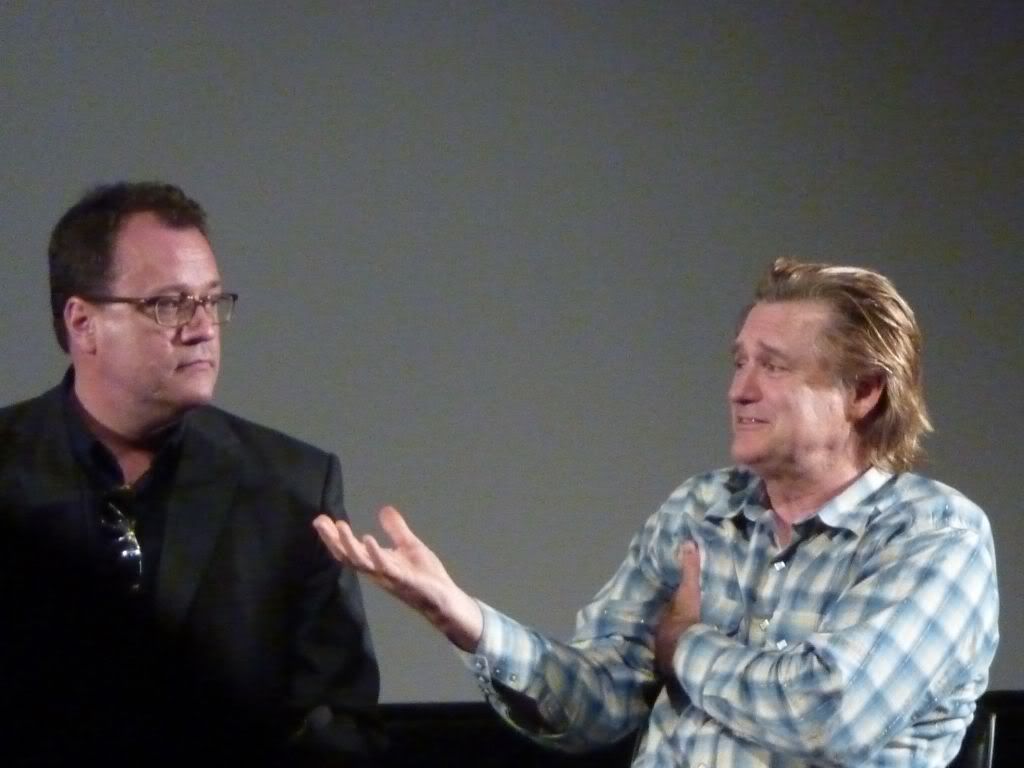
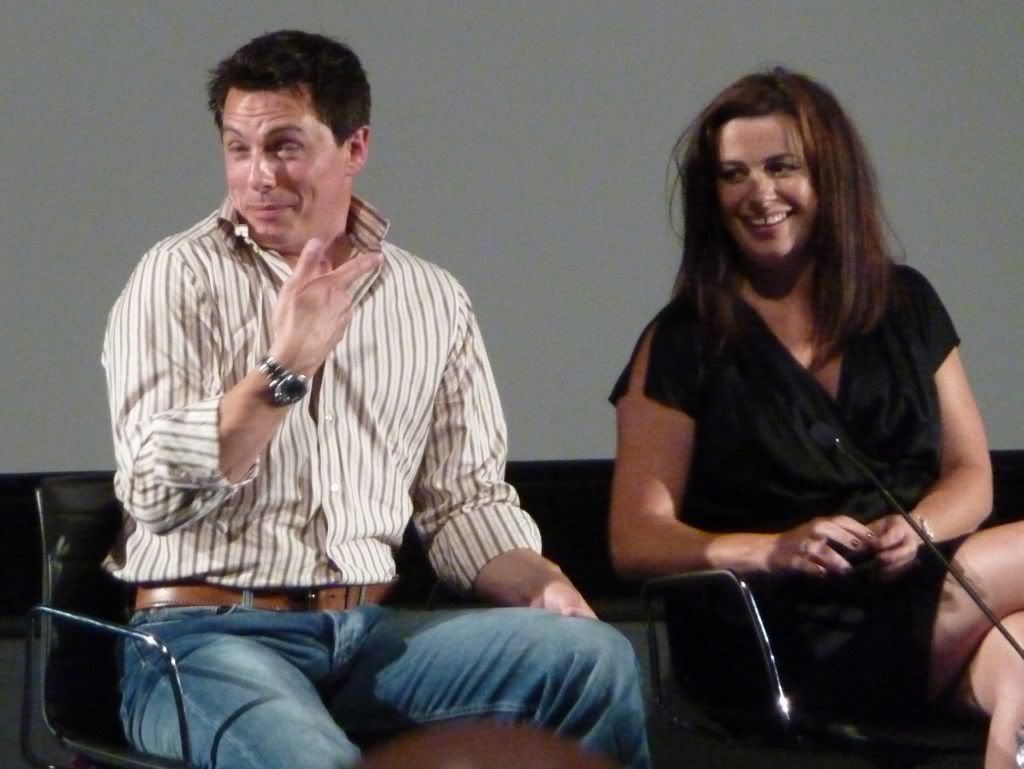
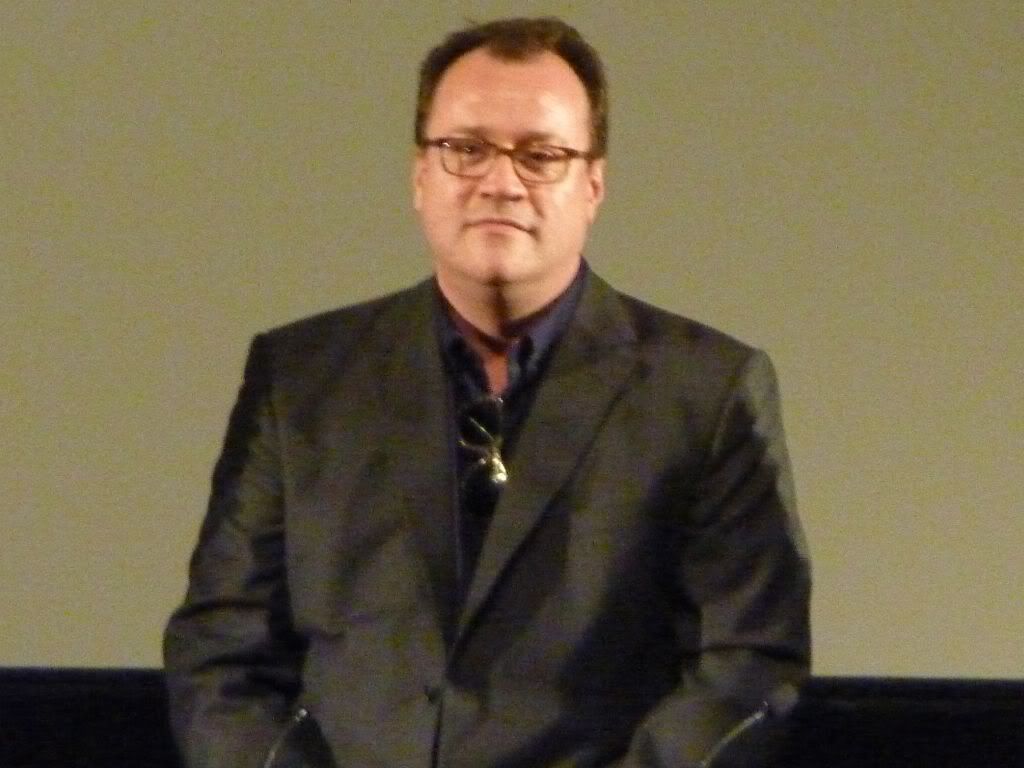
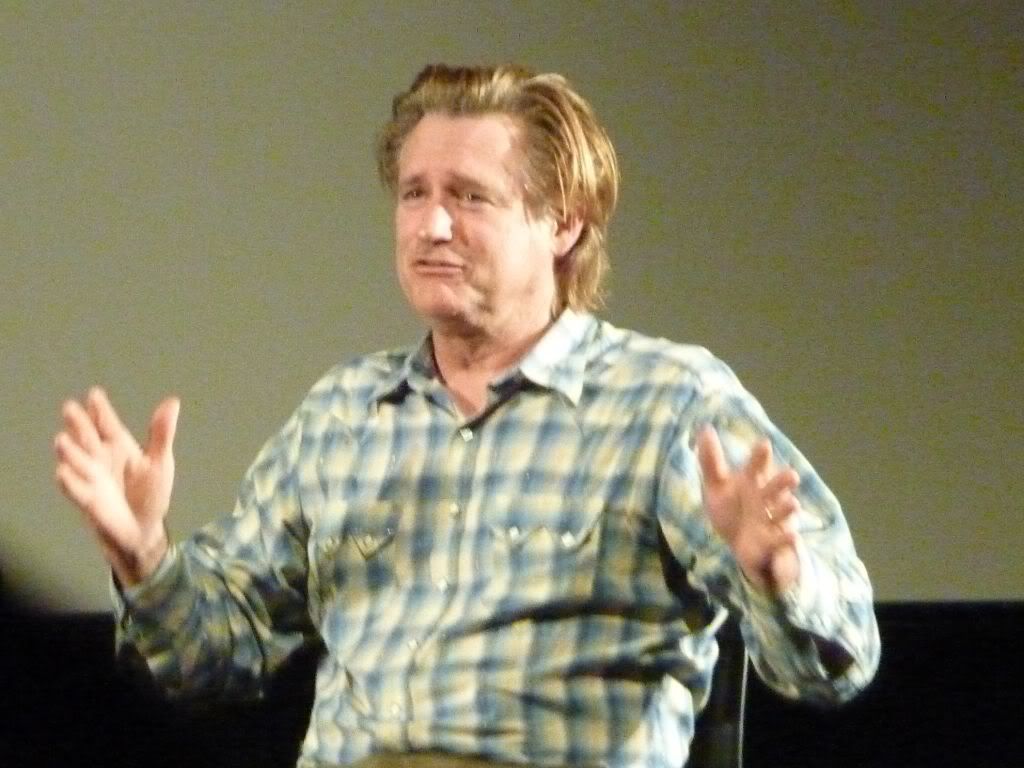
After the episode we were treated to a panel featuring John Barrowman, Eve Myles, Russell T Davies and Bill Pullman, who during the course of the session dipped into how they found filming the series in Los Angeles, how the series and characters have developed, and of course fun and laughter on set (what could you expect from John Barrowman?!!).

It was quite clear from the start that all of the actors found working together to be great fun, not to mention a little mutual admiration between those from the UK and those in the US. Being a self-confessed sci-fi "geek", JB gushed about his crush on BP from Spaceballs and had never expected to work with him at Warner Bros! He was also thrilled to have worked with the likes of Nana Visitor from Deep Space Nine, John De Lancie and Ernie Hudson. BP observed that with the distinguished Welsh cast he knew he was going to work with he was worried that what he termed a "Valley Girl" might be cast on the US-side, but in the end it was a sterling cast and crew all round.

Both JB and EM agreed that part of what they like about Torchwood is how the characters are grounded in reality - they have 'real' personalities, backgrounds and futures, and exhibit the human flaws and foibles. Part of Jack's makeup makes him very similar to Oswald Danes, in that both characters are known to have killed children (though of course in very different circumstances), with JB commenting that makes the two characters finally meeting poignant, both recognising something in the other.

Talking about the relationship between Jack and Gwen, RTD said that there was no romantic relationship between the two characters, and that their friendship comes from the deep respect, trust and affection they have for each other - Gwen has played a fundamental role in keeping Jack "human", and in turn he's been looking out for her family behind the scenes since Torchwood 'vanished'. Of course in reality the two are also firm pals, though John's reknowned capacity for practical jokes 'almost' fractured their friendship when he decided to play a prank of hiding in her shower and jumping out at her after a long early morning shoot, giving her one of the biggest frights of her life.

The cast enjoyed their time on the Warner Bros set in Los Angeles, with the "Hollywood lifestyle" fitting in rather well! With the studio lot so large, travelling about in golf buggies became the norm, though John got his own bicycle, complete with basket to carry his scripts in. Eve was very impressed in the sets they had, especially on how they had faithfully recreated the look of places like Gwen's parents' home (will we be able to spot the difference between the Welsh and Warner Bros versions?!!!).

Commenting on the potential "Americanisation" of the show in future (hopefully!) series, RTD was very frank in saying that should Starz want to continue and the BBC didn't want to co-produce then it could well become a wholly US-centric show; however, he felt that the show's Welsh roots were something that he'd really want to keep if he could. He also heaped praise upon his co-writer Jane Espenson, whose contributions helped bring Miracle Day together. BP revealed earlier in the discussion that upon receiving the scripts for his character it took him less than two days to accept the role based on the quality of writing and the storyline.

Responding to one audience question about the Doctor, RTD made it clear that he should never appear in Torchwood, as that would make children want to watch a show that clearly isn't aimed at them. Characters could move the other way of course, with Jack's origins being in the original show of course, and both Gwen and Ianto had appeared, too (when someone asked about Jack becoming the Face of Boe, RTD wryly pointed out that he wrote that!) JB wouldn't be drawn on whether Jack would be back in Doctor Who though ...

The atmosphere throughout the panel was very upbeat, with everyone on fine form and humourous banter bouncing between themselves. Examples included how RTD joked about BP actually accepting the role as he needed a new kitchen paid for, and EM explaining how JB doesn't like chickens and he responding with a comment about cockerels ...

Conclusion

All-in-all, it looks like the new series of Torchwood is going to be as dramatic as Children of Earth, though whether the plot can sustain itself over twice as many episodes as the former remains to be seen. At least Russell T Davies explained that the storyline is self-contained so we shouldn't end up with a load of potentially unanswered questions at the end of the series like some of the other recently cancelled shows coming out of the States ...

... except of course whether there'll be another series to follow!

Bookmark and Share The Doctor Who Experience

Wednesday, June 08, 2011 - Reviewed by Chuck Foster


Many other photos from my visit can be found on Facebook.
Waking up on a dull-ish Wednesday morning meant two not-so-dull-ish things happening today: firstly, it's my birthday, hoorah; secondly, it's the day we go to the Doctor Who Experience!

Olympia 2 is a strange place; unlike it's massive main companion, the building is a case of "blink and you'd miss it" - only the signs give it away, and then you have security into a plain lift to the second floor ... and suddenly as the doors open you're in a different world!

The key selling attraction of the Doctor Who Experience is, of course, the Experience itself! This takes up the first part of the visit, and is based around a loose script of the Doctor requiring assistance from the audience in order to resolve the problems faced. I'm not going to spoil things here, but essentially you'll meet up with his greatest and his scariest foes, plus the chance to pilot the Eleventh Doctor's TARDIS yourself! (well actually the kids are expected to pilot, but in a small group like ours a big kid like me gets to have a go, too!). There is also a 3D segment that beats the pants off many of the recent films of that style - Pirates of the Caribbean eat your heart out!

The whole experience is perhaps a little disappointingly short in comparison to some attractions you might visit for a similar price range (the London Dungeon comes to mind here), but then of course it isn't the only part of the overall visit, there's the large exhibition to follow, too! Also, its length is comparable to episodes from the original series - your own "Mission to the Unknown", so to speak! However, it is fun and the 'passive' Doctor interaction (as portrayed by Matt Smith) was good, though mayhaps needed a bigger audience than our own group to really work effectively.

Unlike London's other recent exhibition at Earl's Court where you followed a route around the exhibits, here at Olympia 2 it is much more open-plan and you can wander around at your leisure in the order you like. As you exit the Experience you do initially encounter the first ten Doctors in their respective costumes though, surrounding the latest incarnation by the TARDIS. Here you can also get your chance to appear in a (paid) photo within the Pandorica yourself via green-screen.

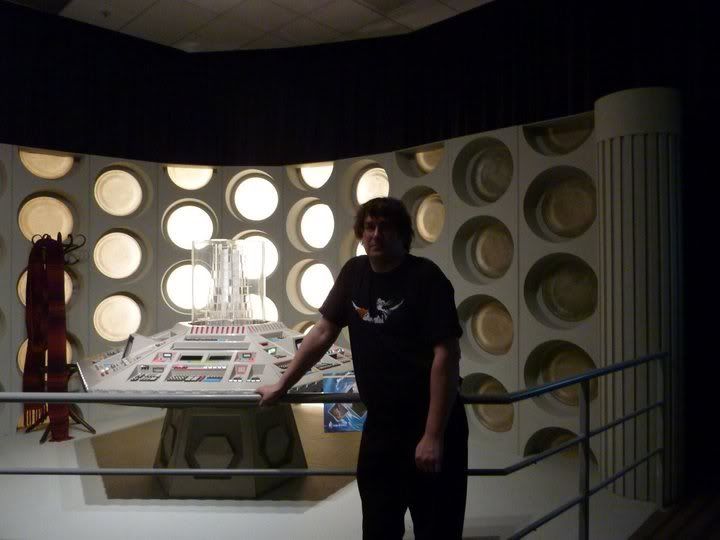
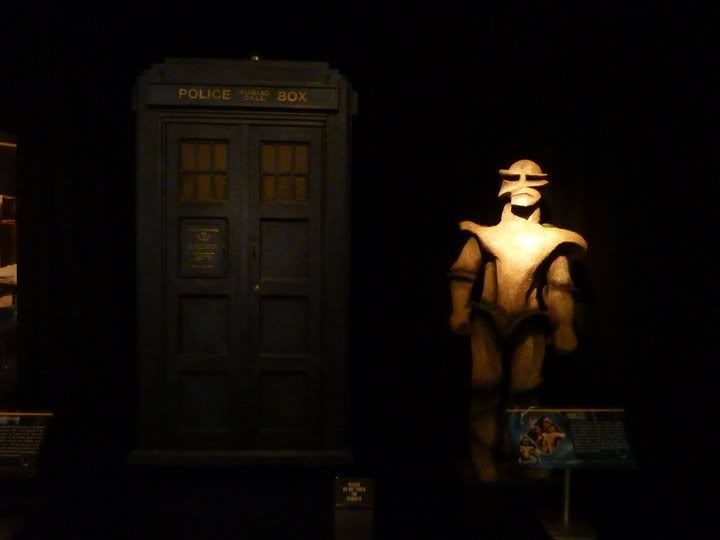
Speaking of the TARDIS, having interacted with the Eleventh's within the Experience, here in the exhibition you'll find both the complete Ninth/Tenth's "coral theme" version and the Fifth/Sixth/Seventh's partial sets, though you can't wander around the consoles, unfortunately. Also lurking in the corner is another TARDIS prop, one of the originals that's almost like an old friend (having had the personal experience of it nearly collapsing on top of me at Panopticons past - eek!).

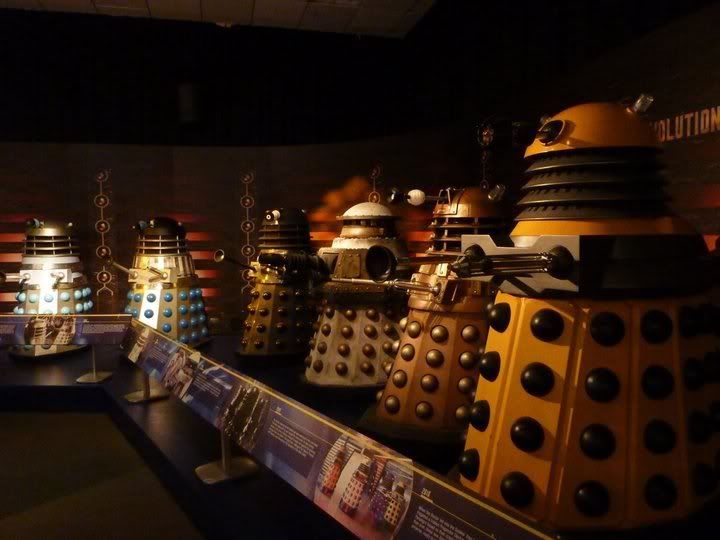
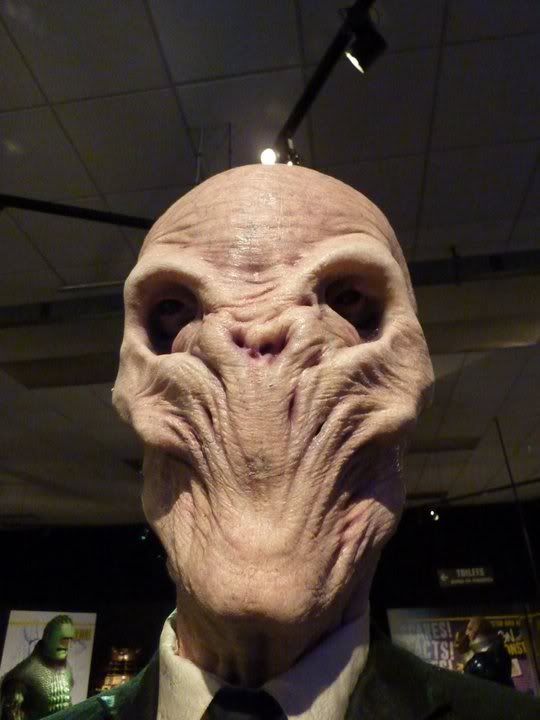
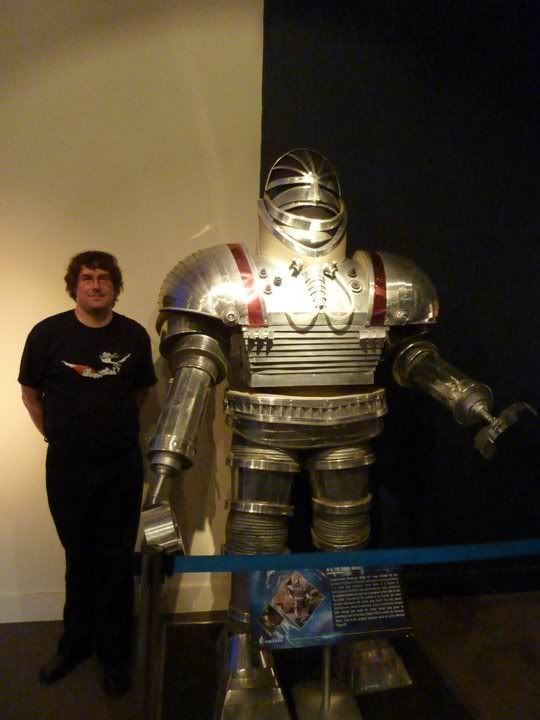
Also on show are a varied collection of companion and monster costumes, including a line-up of cyber-masks through the ages, and a parade of Dalek evolution from their earliest appearance through to the 'chunky' ones from the 2010 series. There isn't that many props from the 20th Century series present, really, but items like the K1 Robot from Robot that tower above you, plus the renovated Ice Warrior and Zygon look really good. Not much from the latest series is present though (or there might have been? I turned away ...)

Other interactive elements include an area where you can learn to walk like the scarecrows from Human Nature/The Family of Blood or stomp like a Cyberman, taught on video by series choreographer Ailsa Berk herself. An obligatory "be a Dalek" prop (which has been around since the MOMI exhibition at the BFI in the early 1990s!). There's also a mock-up of what the BBC Wales art department looks like in all its mayhem.


All in all, you can spend a pleasant hour to hour-and-a-half at the Experience, depending on how much you like to read the information presented with exhibits or watch the video presentations. It's difficult to judge if it is worth the £20 entrance fee with previous exhibitions being half the price, but then the interactive section is fun (and you can see the expense there in places), and there are discounts to be had from various sources - £15 is an average price you can find and that is reasonable in comparison with many of the other London attractions. There is plenty to interest kids and adults alike, though I feel perhaps the former will get more out of the interactive section, and the latter the main exhibition!

Oh, and there's a not-so-little shop!


One amusing incident on the day happened to be in the Experience, as we had a new member of staff accompanying the group to "learn the ropes". At one particularly scary (for the kids you know ...) stage, the long-term member was telling the other all about a certain scary monster and then as they went through a corridor another member of staff leapt out. I think those behind us who didn't see the event must have wondered what that blood curdling scream was all about!

Bookmark and Share Terry Nation: The Man Who Invented The Daleks (Book)

Tuesday, May 17, 2011 - Reviewed by Darren Allen


Terry Nation: The Man Who Invented The Daleks
The Strange Worlds of Terry Nation
Alwyn W Turner
Aurum Press (Book)
RRP £20.00
To be clear from the outset; this is not strictly a biography of Terry Nation. Whilst it does examine his life to a large degree and contain a fair amount of biographical detail, it is more of an examination of his work in context of the times, both social and political. And whilst the book’s approach is not always linear and often groups together Nation’s work for better comparison, in doing so it takes an honest and objective approach to the subject.

Unlike the previous book on Terry Nation, Bignell and O’Day’s very disappointing Terry Nation (Manchester University Press 2004), this admirable tome covers the whole spectrum of Nation’s work, across the media on TV, Radio, film and his two novels, rather than just his three main SF creations. So we travel from his tentative early radio work to his final few pieces for American television. Obviously there is much coverage of Nation’s SF work and in particular the Daleks. Not surprising, given the importance of their creation and reappearances in Nation’s life, but the book also gives a detailed examination of his work on ITC series (The Saint, The Champions, The Persuaders and the like) and the final series of the original The Avengers.

As I mentioned earlier, the book is not a detailed biography of Terry Nation. At times it is rather brief on some personal details. His wedding to Kate and the birth of his son Joel are only mentioned in passing. Whilst the birth of his daughter, Rebecca, is not mentioned at all! In fact you would only know that he had a daughter, because of the book that he wrote for her: Rebecca’s World. But Turner is accurate in his belief that it is one of Nation’s best pieces of work.

It was good to read the details behind Nation’s 1972 Drama Playhouse episode The Incredible Robert Baldick. A programme that I have always viewed as ‘the one that got away’, as it had series potential, and it is good to see that Turner agrees. The format of a gentleman adventurer travelling Victorian England, investigating the supernatural was sadly ahead of its time and is ripe for rediscovery.

Whilst Turner is correct in championing Nation’s legacy and that his three big creations (Daleks, Survivors, Blake’s 7) all enjoyed a renaissance after his death, he is a little anti the new Survivors, which is odd given what producer Terence Dudley did to the original series after Nation’s departure. His assertion that in the second series of the remake “there was little left resembling Nation’s original work” is rather sweeping. I personnally felt that the second series was more coherent as a whole and that it did contain some Nationesque themes. Particularly, the fourth episode wherein Tom and Greg are put to work in a mine by feudal overlord Henry Smithson (Christopher Fulford); a scenario that would have fitted in with Nation’s original first series perfectly.

As Turner observes, the great tragedy of Nation’s life is that having moved to America in 1980, he was to spend the last seventeen years of his life caught up in the studio system and sadly only notch up four writing credits.

In such a work, there are always likely to be a couple of mistakes or omissions. Such as in the précis of Nation’s second series Blake’s 7 episode Countdown, where he has Blake, rather than Del Grant defusing the bomb with Avon.

Also, in covering Nation’s desire that the Daleks did not become figures of fun (goodness knows what he would have made of his agent’s u-turn since 2005), Turner details the one exception to this: The ‘Pakistani Daleks’ sketch in Spike’s 1975 Q6 series. Although he is correct that Nation allowed it as a favour to Milligan, he somewhat surprisingly omits mention of the fact that Milligan was initially turned down by Nation’s agent and it was only when Milligan personally wrote to Nation (and reminded him of how he had helped the younger, struggling Nation) that the sketch went ahead. This is a very surprising omission given the sheer amount of research that Turner has done and the information on Nation’s work that he does include.

As these are the few examples of what is wrong with the book, they certainly do not detract from what is one of the best books concerned both with Doctor Who, and British television in general, published for many years.

I heartily recommend this book to anyone either with an interest in Terry Nation or television production from 1960 to 1980. And although you might not always agree with Turner’s comments, they are strongly put. One final thought: In nearly 300 pages of text (plus a thorough list of Nation’s writing credits), there is not one mention of Terry Nation’s predilection with the name Tarrant. Refreshing!

Bookmark and Share Genesis of the Daleks (CD)

Thursday, February 10, 2011 - Reviewed by Darren Allen


Genesis of the Daleks
Vintage Beeb,
AudioGo (CD)
RRP £6.10
Purchase from our Amazon Shop
The latest batch of BBC Vintage Beeb releases (the third), wherein BBC LPs/tapes of the 1970s are reissued on CD, in some cases for the first time, includes another outing for Genesis of the Daleks. This is its fourth release; following the original LP/cassette release in 1979, the BBC Radio Collection double cassette pairing with Slipback in 1988 and the expanded CD release of 2001 paired with Exploration Earth.

I have two problems with the Vintage Beeb range. The first concerns the very concept of a 'Vinyl replica'. Now to me, like a lot of people, this means a faithful replica of the original album sleeve in cardboard. This is something that the Japanese have been doing with albums for nearly twenty years; releasing faithful reproductions of many albums in exact detail with gatefold sleeves, embossed sleeves, cut outs, inserts etc. Even with some EMI albums of the early 1980s they have exactly replicated the paper inner bag complete with the "home taping is killing music" logo and slogan! (Apologies for those readers under forty for which this will mean nothing. But believe me it shows attention to detail!)

Unfortunately to BBC Audio/AudioGo, 'Vinyl replica' just means a reissue of a title onto CD in a standard jewel case but now with the original sleeve artwork/photo used on the booklet and a black CD. The latter is a nice gimmick, but it hardly makes the release a replica!

The second problem is that whilst we are seeing some long unavailable albums such as I’m Sorry I’ll read that Again released onto CD, this range still contains a number of titles previously released on CD as part of the BBC Radio Collection. Monty Python’s Flying Circus, The Magic Roundabout and Genesis of the Daleks to name but three. The question on a lot of peoples’ lips is "When are we going to see a CD release for the themes albums that were a mainstay of the BBC Records and Tapes range of the 1970s?" I would dearly love a re-mastered copy of 1979’s BBC Space Themes as my original tape is showing its age... but then it is thirty years old! I suppose the problem here is that is easier to clear the rights for BBC shows, rather than music collections.

I remember buying the original release of Genesis of the Daleks back in 1979, when it was timed to coincide with the screening of Destiny of the Daleks. At the time it was hoped that it would be the start of a series, but despite being a consistent seller it was sometime before we got a range of Doctor Who audio releases!

Even now, Tom Baker’s opening line "I stepped from the TARDIS onto a bleak planet..." is as great a hook as ever, drawing the listener in to a breakneck version of the original TV story. Although the ensuing argument with the Time Lord about interrupting a transmat beam jars somewhat! The linking narration fits very well, filling in the gaps of story inherent in condensing a six-part TV story down to under an hour’s worth of LP. And Tom’s reading is superb, as we move from one memorable scene to the next. Only being an hour long, such a short version should not work; but it does and all credit to Derek Groom who produced it back in 1979.

There is one difference to the original audio release though. That annoying jump cut at the end of side two of the original LP, wherein the theme cuts in halfway through the Dalek’s closing line resulting in "we will take our rightful place as the supreme power of the univer", has been rectified in line with the previous CD release, so you now get "universe" in all its glory. Whether this is a good thing or bad, I leave to individual choice!

Despite problems with presentation, to quote Destiny of the Daleks, "Its what’s on the inside that matters." This is still a very valid release and heartily recommended for two reasons. Firstly, it does reproduce the original 1979 release complete with end of side one cliff-hanger. And secondly, it can be ordered online for not much over £4, making it very good value!

Bookmark and Share Meglos (Region 2 DVD)

Monday, January 17, 2011 - Reviewed by Anthony Weight


Meglos
2|Entertain Ltd (DVD Region 2)
RRP £19.99
Purchase from our Amazon Store
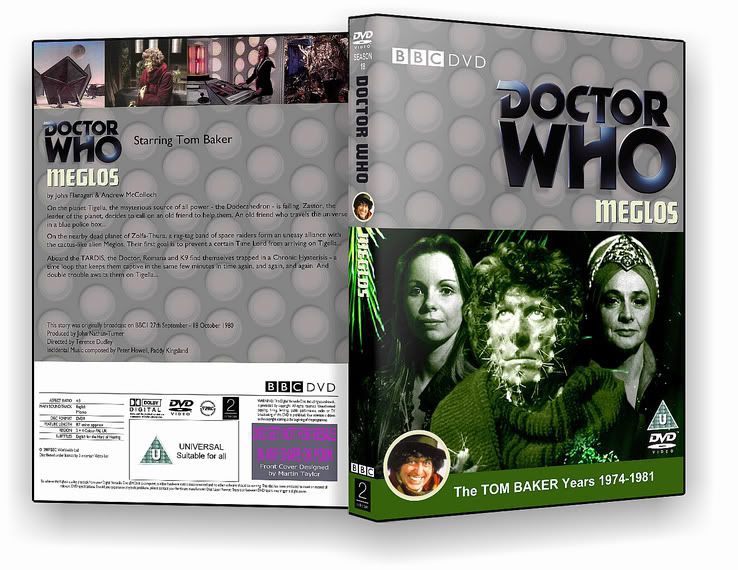
Poor old Meglos always seems to be the overlooked, under appreciated child of season eighteen. Sandwiched between the new-look relaunch story The Leisure Hive and the TARDIS crew-changing trilogy of the E-Space stories, its lack of any particular hook or event which makes it an important part of either the mythos of the show or the nature of its production means it tends to be rather forgotten about.

Which is a great shame, and I hope its turn to be released on DVD sees it getting a little more recognition than it hitherto has. Although it does have some of the po-faced faux-science that runs through all of season eighteen (why not just call it a “Time Loop”, rather than a “Chronic Hysteresis”?), it runs at a much faster pace and has a much more involving story than its immediate predecessor, with John Flanagan and Andrew McCulloch doing a good job of creating an interesting story of science versus religion with characters who you actually want to know what happens to them.

Nowhere does their ability to create worthwhile characters come across more than the main villain, Meglos, who is possibly the most interesting villain to turn up anywhere in this season. His first appearance, as the random cactus with the disembodied voice, ought to seem utterly absurd and ridiculous, but somehow the vocal performance lends a genuine air of intellect and menace. As the story moves along, Tom Baker’s performance as Meglos impersonating the Doctor also works well.

Admittedly it does have to be said that Meglos impersonating the Doctor creates one of the weak points of the story, when the Tigellan scientists are so ready to accept that the Doctor has been impersonated, and to believe his story. It’s a shame that in a script where they generally do so well that Flanagan and McCulloch do lapse into some lazy writing every now and again – another case in point being Romana leading the Gaztaks, who hitherto been interesting and funny characters, round and round in circles through the forest like a bunch of space morons. And on another note, why didn’t they recognise her from their watching of the Chronic Hysteresis on Meglos’s screen, anyway...?

Quibbles aside, the aforementioned forest is one of the better ones to have been attempted within the confines of a multi-camera studio on Doctor Who down the years. In fact, the whole of Meglos looks pretty damn good – Terence Dudley having perhaps his finest outing as a director on the programme. He’s able to get the infamous lighting levels down for some of the Gaztak spaceship and Deon worship scenes, and he’s lucky enough to have great support from make-up (the Meglos cactus facial make-up on Christopher Owen and Tom Baker) and the more technical departments (the excellent Scene-Sync work).

There’s a very good guest cast been recruited, too – notably Bill Fraser, Frederick Treves and yes, even Jacqueline Hill coming back to a series that must have been so bamboozingly different from that little programme she left back in Lime Grove all those years ago. She’s let down by Lexa’s death scene, though – which is rushed, pointless and basically thrown away.

If you’ve not seen Meglos before, or if you haven’t given it a look for some time, I’d recommend picking this up if you get the chance. You might be pleasantly surprised – it’s a reminder that even in its uncelebrated instalments, Doctor Who can provide more entertainment than an average piece of television.

Extras


As always, we’re spoiled on Doctor Who, with even a “run of the mill” story such as Meglos receiving a bonus feature package which puts most feature films to shame. The commentary, which features Lalla Ward, John Flanagan, Christopher Owen and Paddy Kingsland, probably doesn’t contain anything startlingly insightful, but is amiable enough, and it’s interesting to note how on occasion Ward seems to slip into a moderator-type role, leading the discussion and asking questions of the others.

My favourite of the bonus features was Meglos Men, an interesting way of looking at the writing of the story. Rather than simply being talking heads in a studio, Flanagan and McCulloch meet up and travel around some of their old London haunts in a very nicely-shot and interesting feature which even sees them pop round Christopher H. Bidmead’s house. I don’t think they’re writers who will be as familiar to most Who fans as some others who have worked on the series, so it’s worth a look to find out a bit more about the background to the writing of the serial.

The Scene Sync Story is an interesting look at the technology behind the innovation which helped make the Zolfa-Thuran scenes of Meglos look so good, locking two cameras of a Chromakey shot together. I am very interested in this sort of behind the scenes, production history nitty-gritty, although I appreciate it’s not everyone’s cup of tea.

The Jacqueline Hill documentary, A Life in Pictures, is very welcome, although I couldn’t help but feel it would have been nice for it to have been longer, and to have included some more clips of her work outside of Doctor Who. I appreciate that this probably would have involved clearance costs, though, and doubtless the money was better spent elsewhere on the release.

I didn’t like Entropy Explained very much – this sort of ‘educational’ type feature may be an interesting idea for a different type of extra, but I just don’t think it works. It’s Doctor Who, after all, not real science, and exploring the real scientific concepts stories may sometimes play with probably only flags up how dodgy the science of the stories often is. Plus it doesn’t seem to be able to decide if it’s trying to be serious or funny, with the presentation style playing it straight, but the captions throwing in Hitch-Hiker’s Guide jokes and shampoo advert references.

There are the usual goodies in terms of production note subtitles, a photo gallery and PDF materials to be had, too – all-in-all, the typical very high standard we’ve come to take for granted on the Doctor Who discs.

Bookmark and Share Doctor Who: Series 5 Soundtrack

Monday, November 08, 2010 - Reviewed by Anonymous

Written by Stephen Willis

Doctor Who: Series 5
Music written by Murray Gold
Silva Screen
UK release: 8 November 2010
Like the Series 4: The Specials release, this album is also a 2-disc set. The result of this is that it really feels like a soundtrack, like a journey from A to B with a wealth of characters and themes in between, rather than the more “pick ‘n’ mix” approach to the first few releases.

We begin with Doctor Who XI – Murray Gold’s brand new rendition of the Doctor Who Theme, for a brand new era of the show. And it is stompingly good! The brass fanfare over the introductory bars took a few people by surprise (myself included), but it’s perfect for the tone and feel of the show in Steven Moffat’s hands, and it matches the opening titles very well, too.

What follows is a selection of tracks from the opening story, The Eleventh Hour. This episode had to introduce a new Doctor, a new companion (at two different ages) and a brand new feel for the show. Even a new TARDIS! Murray Gold brilliantly does the same thing in his music. This episode features some of my favourite tracks from the series; the haunting, sweet little melody for Little Amy, the exuberantly comic Fish Custard, the devastatingly beautiful Can I Come With You?, the magical The Mad Man With A Box, and, of course, I Am The Doctor.

As a theme, I Am The Doctor is excellent; its quirky, syncopated 7/4 beat and wacky, playful woodwind melody is perfect for Matt Smith’s Doctor, while the relentless strings and cyclic horn chords show us a darker side. The “B section”, as featured in The Sun’s Gone Wibbly, is also a fantastic tune, a rousing chorus as the Doctor encourages people to be their best. The theme’s rendering on this album (in its original form on Track 9) is slightly disappointing, because of the intrusively percussive guitar line which didn’t feature in any screened version, but the other versions such as Onwards! and at the end of Amy In The TARDIS more than make up for this. The theme’s frequent use in the series is echoed by its many guises on the album – no complaints from me, though, as it’s a superb composition.

Amy’s Theme does not appear until the beginning of episode 2, The Beast Below. As with Rose’s Theme in Series One, it’s almost as if travelling with the Doctor has unlocked the song in Amy’s heart, as we hear it for the first time here as she floats above the TARDIS gazing at the stars. This creates an emotional connection for the audience, so that, when the theme is developed in later episodes, we are able to simultaneously call back to the beginning of Amy’s journey and look forward to the future of her character arc.

One particular standout track is The Vampires of Venice. It’s very Danny Elfman in its use of the “dark fairytale” sound-world (tremolando strings, fluttering flutes, celesta and “floaty” choir). It’s magical and mysterious, and builds to an epic action sequence with crash cymbals and very loud “Hah!”s from the choir!

There is also some nice material from Amy’s Choice – This is the Dream reminds me slightly of the McCoy era music, such as Dominic Glynn’s score to Survival. The Hungry Earth / Cold Blood begins with a lyrical valley theme, setting the tone at the start of the episode, while the Silurian theme contains hints of the old-style Pertwee era music (Malcolm Clarke’s bizarre electronic sounds of The Sea Devils). Orchestral power builds up with the taste of war and aggression, with a deeply unsettling undertone.

Onto Disc 2! There is some fantastic music in Vincent and the Doctor, in its own world of clarinets, saxophones and mallet percussion, most notably in the beautiful “With Love, Vincent” from the end of the episode, a lilting waltz with a pang of sadness, yet ending on a positive outlook.

Gareth Roberts’ The Lodger was unique, fresh and FUNNY! And so is Murray’s score. The tune for Craig and Sophie (Friends and Neighbours), is lovely, gentle and wistful, while the next two tracks have a distinctly silky clarinet solo, suggesting the strange impact the Doctor has on these ordinary lives.

Most of Disc 2 is dedicated to the series finale, The Pandorica Opens / The Big Bang. And quite right, too – the score to these episodes is hugely cinematic, with great scale and depth. Beneath Stonehenge is a track John Williams would be proud of, while the following track, Who Else Is Coming? is simply crazy in its escalating panic and mayhem! The bombastic horns give a sense of drama and danger, and the energetic strings and flourishing woodwinds keep an undercurrent of fear, while complementing Matt Smith’s quirky, edgy performance as the Doctor.

At the climax of the first part come two tracks, Words Win Wars and The Life and Death of Amy Pond, which are based on character themes and have both been given similar treatment. The former is the stirring, rousing reprise of I Am The Doctor played during the Hello, Stonehenge! speech, and the latter is a fully orchestral version of Amy’s Theme, which wouldn’t be out of place in a ballet or opera; it’s as if a moment of time has been frozen, as we watch with pity as the Doctor is dragged into the Pandorica, and the universe seemingly disappears from existence as Rory hopelessly clings onto the dead body of Amy Pond.

For me an underrated track, Roman Paradox is a perfect madcap moment as the Doctor appears in front of Rory at the start of The Big Bang. The Patient Centurion is also excellent, as a poignant reflection on Rory’s devotion to Amy. This cue was used earlier in the series as well, so by now it has a strong emotional connection to the characters involved.

Both The Sad Man With A Box and You And Me, Amy feature variations on The Mad Man With A Box, a secondary, more emotional and mysterious, theme for the Eleventh Doctor. You And Me, Amy is perfectly gentle and touching, as the Doctor resigns himself to his fate and tells little Amelia a final bedtime story. This is surely one of Matt Smith’s finest performances in the series, accompanied by the perfect score.

Overall, this album is superb; it tells a story with such depth and sensitivity, exploring a wide range of genres and sound-worlds. The album finishes with Onwards!, another reprise of I Am The Doctor, which is perfectly placed and executed, finishing on an imperfect cadence, a musical cliffhanger as the TARDIS team fly off, laughing, with promise of more adventures to come.

Stephen Willis is the creator of The Doctor Who Fan Orchestra.